

The CEO Bottleneck: How to Stop Being the Constraint in Your Business
You built the business by being involved.
You made the calls. You caught the mistakes. You kept things moving. And now growth depends on you.
If every important decision, approval, client escalation, and “quick question” routes back to you, you don’t have a motivation problem.
You have a systems problem.
In systems terms, you are the constraint. The CEO bottleneck.
This is common in small-to-mid businesses. Especially when the founder is the most experienced person in the room, the brand is tied to their expertise, and the team is lean.
The good news: you can fix it without turning your business into a bureaucracy.
This post will help you understand why the founder bottleneck happens, how to spot it, and what to do next.
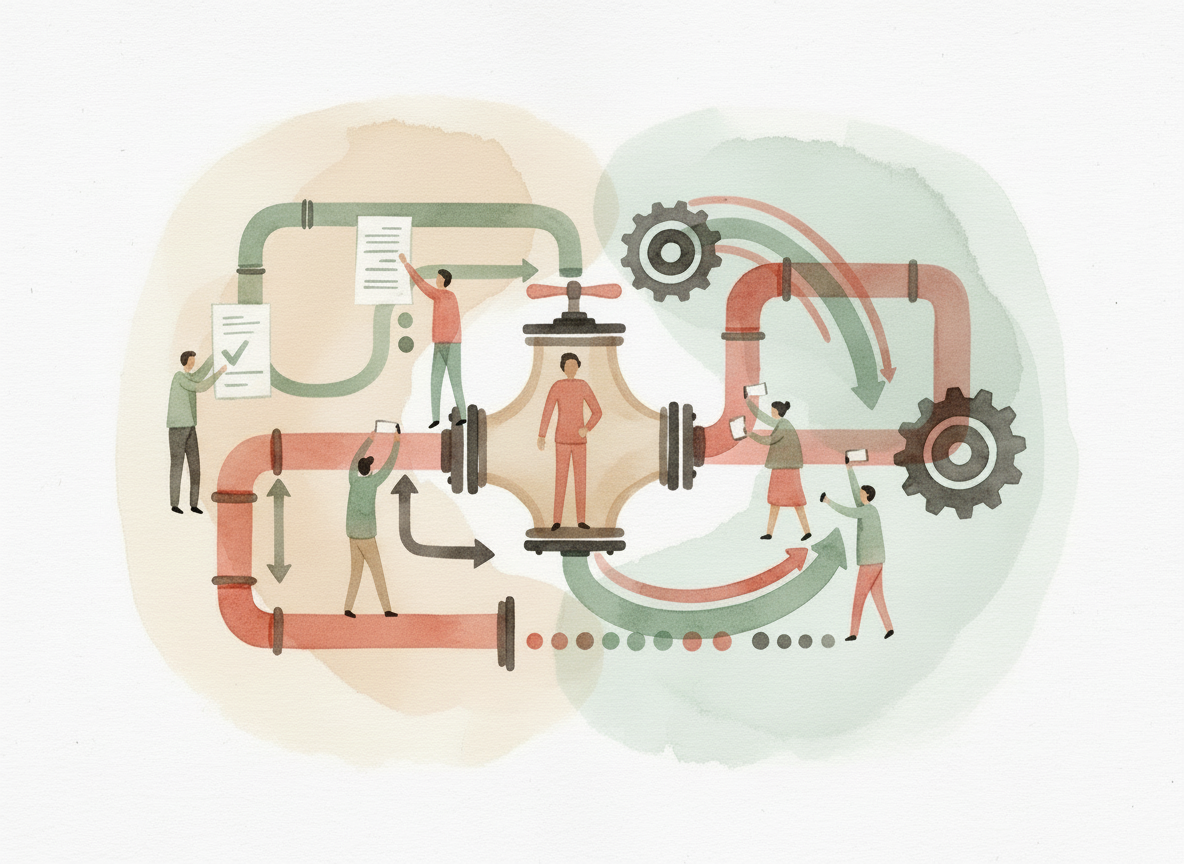
The hidden cost of being “needed” everywhere
Being needed feels like control.
But it has a cost:
Slow execution: work waits for your approval
Lower quality: people guess what you want instead of following standards
Team dependency: capability doesn’t grow because decisions don’t move
Burnout risk: you never truly switch off
Fragile growth: the business can’t scale beyond your attention
If you’re constantly firefighting, it’s not because you’re bad at leadership.
It’s because the system is designed to pull you in.
Why it happens (systems view)
Most CEOs try to solve the bottleneck with willpower.
“I just need to delegate more.”
Delegation helps, but it fails when the underlying system stays the same. Here are the common system causes.
Decision rights are unclear
When nobody knows who can decide, the safest path is to escalate to the CEO.
This shows up as:
endless Slack questions
approvals for small changes
meetings that exist only to get a decision
If you want fewer escalations, you need clearer decision rights.
Work is designed around the founder
Many businesses quietly build processes that assume the founder is the hub.
Examples:
proposals require your custom input every time
marketing can’t publish without your review
client onboarding depends on your personal touch
If the workflow assumes you, you will always be busy.
No operating cadence
Without a predictable rhythm, everything feels urgent.
A simple cadence creates a place for decisions to land. Without it, your team pings you in real time.
Trust and proof are missing
Delegation requires trust. Trust requires proof.
If standards are unclear and outcomes aren’t measured, delegation feels risky. So you keep control.
This is not a personality flaw. It’s a missing feedback loop.
9 signs you’re the CEO bottleneck
You might be the constraint if:
Projects stall when you’re away.
Your calendar is full of approvals and “quick checks.”
You are the default problem-solver for client issues.
You rewrite work instead of reviewing it.
People wait for your input before moving forward.
You are the only person who understands the full plan.
You feel like you can’t trust the numbers.
You are involved in too many tools, threads, and handoffs.
Growth initiatives keep getting pushed because operations take over.
If you nodded at more than three, you’re not alone.
Now let’s fix it.
What to do next: a practical de-bottleneck plan
You don’t need a massive reorg, you need to redesign flow.
Step 1: Map where work waits for you
For one week, track every time work pauses for you.
Create a simple list:
what was waiting
who was waiting
why it needed you
what decision was required
Patterns will appear fast.
This becomes your bottleneck map.
Step 2: Define decision rights (RAPID-lite)
You don’t need a complex framework. You need clarity.
For recurring decisions, define:
Owner: who makes the call
Input: who must be consulted
Approval: what requires CEO sign-off (keep this small)
Timing: when decisions happen (weekly window)
Start with the decisions that hit you most:
pricing exceptions
content publishing
client escalations
vendor selection
Step 3: Create “definition of done” and standards
Most CEOs become bottlenecks because work comes back half-finished.
Fix that with standards.
Create lightweight checklists for:
proposals
client onboarding
campaign launch
reporting
Your goal is not perfection.
Your goal is repeatability.
When standards exist, review becomes faster and delegation becomes safer.
Step 4: Install a weekly operating cadence
A cadence reduces interruptions.
A simple version:
Monday: priorities and owners
Midweek: decisions and blockers
Friday: results, learnings, next week
This creates a predictable place for:
escalations
trade-offs
approvals
Instead of constant pings.
Step 5: Delegate outcomes, not tasks
Delegating tasks keeps you involved, delegating outcomes builds ownership.
Bad delegation:
“Write this email and send it to me.”
Better delegation:
“Own the follow-up sequence. Here’s the goal, the guardrails, and when I want the first draft.”
Give:
the outcome
the constraints
the standard
the deadline
Then let them solve.
Step 6: Build feedback loops and scorecards
Delegation sticks when you can see reality.
Pick a few metrics that reflect flow:
speed to lead
projects delivered on time
client issues per week
conversion rate at your main CTA
Review them weekly.
If something slips, you adjust the system. Not by taking the work back.
When you should not delegate (yet)
Some things should stay with you for now:
defining the company’s positioning and strategic direction
hiring and performance decisions
high-stakes client conversations (until your team is ready)
The goal is not to disappear.
The goal is to stop being the choke point for everything.
Want help removing the constraint?
If you want to remove the CEO bottleneck without losing quality or control, I can help you map the constraint, define decision rights, and build a simple operating system your team can run.
