

The Quick Customer Journey Map That Finds Revenue Leaks
If your marketing is generating interest but revenue is not moving, you might be dealing with a hidden problem.
Not a channel problem. Not a “we need more leads” problem.
A revenue leak problem.
Revenue leaks happen when the customer journey has friction, broken handoffs, or unclear next steps. The worst part is that you can’t see them in a typical marketing report.
Clicks can look great while customers quietly drop out.
The good news: you do not need a six-week workshop to map your customer journey.
You need a simple, practical map that shows where money is leaking out of the system.
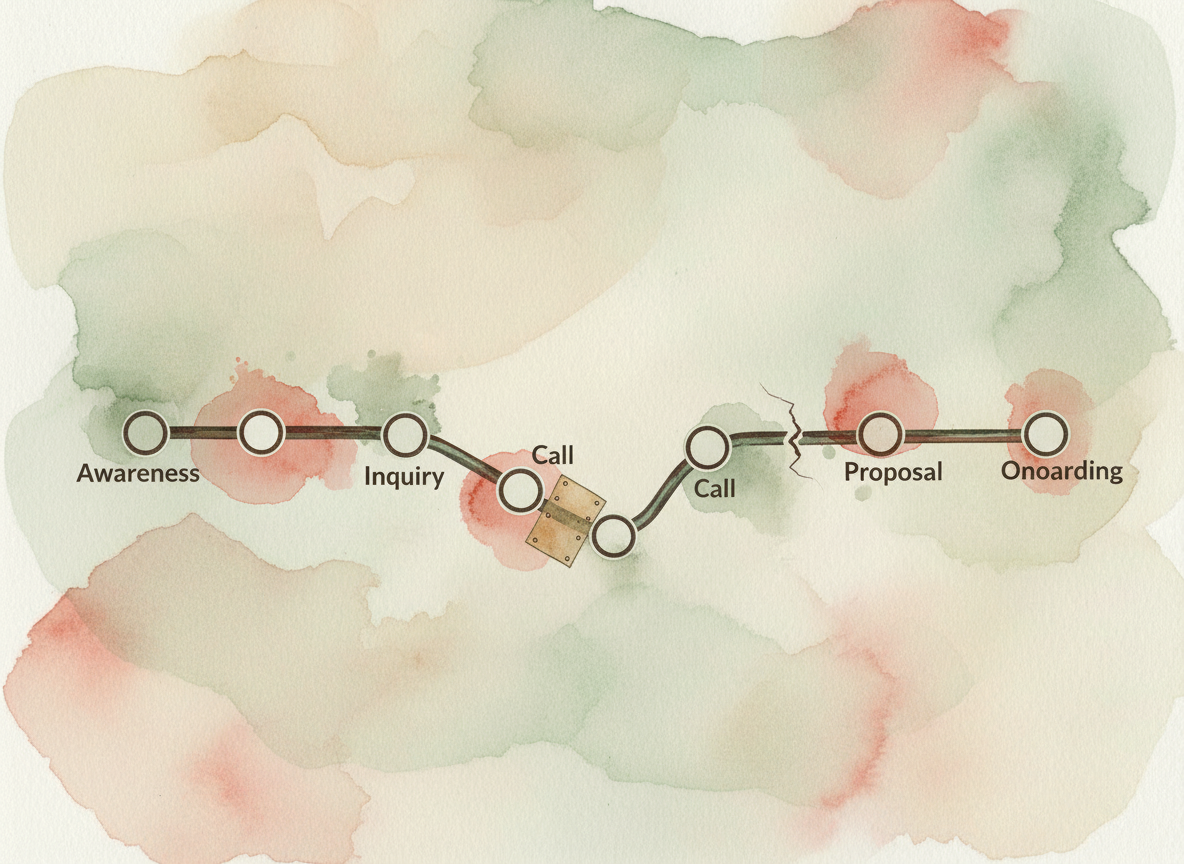
The problem: growth stalls even when marketing is “working”
Here is what this looks like in real life:
Leads come in, but sales cycles drag.
Calls happen, but close rates stay flat.
Customers buy once, then disappear.
Your team is busy, but you can’t point to what is improving.
That is usually a sign that the journey is not designed. It is accidental.
Why it happens: revenue leaks across the system
From a systems perspective, growth is flow.
If flow slows down, it is because something is creating friction or confusion.
Friction points you can’t see in channel reports
Channel reports show activity. They do not show experience.
A customer can:
click an ad
read a page
open an email
…and still feel unsure what to do next.
Uncertainty is friction.
Handoffs that break trust
Handoffs are where customers decide whether you are reliable.
Examples:
A form submission gets no response for two days.
A sales call ends with “we’ll send something” and nothing arrives.
A new customer gets onboarding instructions that don’t match what was promised.
Each handoff is a trust moment.
Offers that don’t match intent
A customer journey breaks when the offer is wrong for the stage.
If someone is early in research, pushing a hard close can feel aggressive.
If someone is ready to buy, giving them a generic brochure feels like a stall.
The simple mapping method (60 minutes)
This is the method we use with busy CEOs because it is fast and it produces decisions.
Step 1: Pick one customer path
Do not map everything.
Choose one path, for example:
LinkedIn post → website → book consultation
Referral → discovery call → proposal → close
Google search → service page → contact form
Pick the path that matters most right now.
Step 2: Mark the moments that matter
Write the journey as a simple list of steps.
Then mark the moments that matter, for example:
first impression
first response time
first call
proposal moment
onboarding moment
first value delivered
These are the points where customers decide to continue or drop.
Step 3: Add evidence, not opinions
For each step, add one piece of evidence:
conversion rate
time to respond
drop-off point
common objection
customer question you keep hearing
If you do not have data, use a quick proxy:
scan emails
review call notes
ask sales for top 3 objections
You are not trying to be perfect. You are trying to be directional.
Step 4: Choose one leak to fix first
Do not try to fix everything.
Pick one leak that is:
frequent
close to revenue
easy to test
Examples:
response time after inquiry
unclear next step after a call
proposal follow-up process
What to fix first: the constraint rule
If you fix the wrong thing, you will feel busy and still not grow.
Use a simple rule:
Fix the step where the most value is getting stuck.
That is your constraint.
Once the constraint improves, the next constraint will appear. That is normal.
Need help mapping and fixing your costumer journey?
If you want, GLXP Solutions can help you map your highest-value journey and identify the one leak to fix first.
